Tuesday, April 25, 2006
New cells + new introduced worker
Over the past few days, I have noticed a slow but steady increase in the number of new cells. Most of these now have eggs in them; a couple already house larvae.
There is now a fourth worker, bringing the colony size to five. However, this worker did not hatch out from this nest. I obtained her after a failed nest relocation. I installed another nest of this species outside my window, but did not give them enough time to adapt to the new surroundings. The queen and two workers thus flew away. The remaining worker deserted the nest and flew into my living room from the window.
Recalling several incidents when foreign workers joined another nest, I caught her and decided to try something. I put her in a container for a couple of hours to make her less flighty, then gently opened the cover and raised the container to this nest. She climbed out without hesitation. The queen and two other workers immediately gathered around and appeared to be "licking" or gently biting her. This is probably a way of enforcing their dominance. However, she was quickly accepted into this colony, and soon started foraging and even repairing cells.
There is now a fourth worker, bringing the colony size to five. However, this worker did not hatch out from this nest. I obtained her after a failed nest relocation. I installed another nest of this species outside my window, but did not give them enough time to adapt to the new surroundings. The queen and two workers thus flew away. The remaining worker deserted the nest and flew into my living room from the window.
Recalling several incidents when foreign workers joined another nest, I caught her and decided to try something. I put her in a container for a couple of hours to make her less flighty, then gently opened the cover and raised the container to this nest. She climbed out without hesitation. The queen and two other workers immediately gathered around and appeared to be "licking" or gently biting her. This is probably a way of enforcing their dominance. However, she was quickly accepted into this colony, and soon started foraging and even repairing cells.


Sunday, April 23, 2006
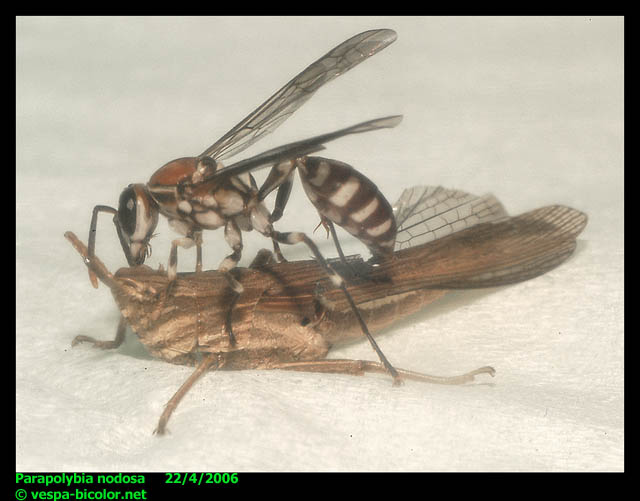
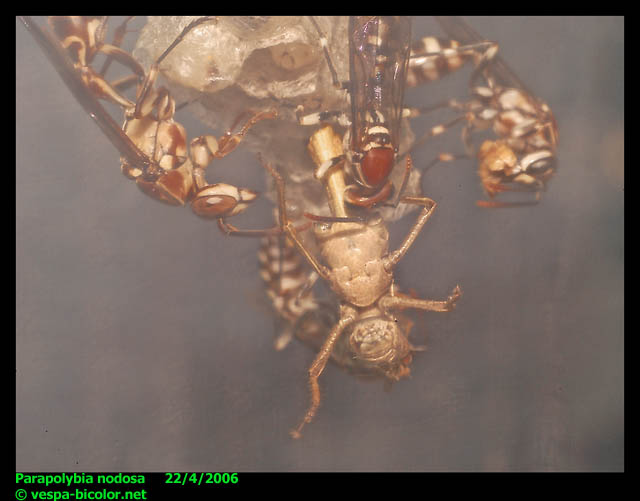
I gave the wasps another grasshopper. This time, I used the forceps to place the grasshopper directly on the nest surface. The wasps reacted violently; they latched on and stung the grasshopper continuously. Being quite heavy, it dropped off the nest, with one wasp still latched on to it. This wasp continued to bite and sting, even though it was being dragged around the enclosure by the much stronger grasshopper. The wasp bit one of the grasshopper's antennae, plunging her sting repeatedly into the abdomen all the while. Finally, the grasshopper weakened and toppled over. A result of the stinging? The wasp bit off a leg and flew back to the nest. I then picked it up with the forceps and slowly offered it to the other wasps on the nest. This time, the combined efforts of the other wasps enabled them to dismember it without dropping it.
Saturday, April 22, 2006
Recent photo

Here is a photo of the nest with three workers. I accidentally banged on the tank wall while opening the cover; this is the reason why the two workers at the top are in a defensive posture. The two older workers are also very mobile now, flying around the tank throughout the day.
Friday, April 21, 2006
A new worker hatched today.
I am busy at the moment, so I shall check back and photograph them later.
Thursday, April 20, 2006
Unusual food hanging behaviour.

I offered the wasps a small grasshopper today. I had to use forceps for this, but since the grasshopper's head was far away from the tip of the forceps, they weren't really bothered. All three pounced on the grasshopper, stinging it repeatedly before proceeding to bite and chew it open.
Some unusual behaviour was seen today. The grasshopper, though small, was bigger than the wasps, and obviously had lots of flesh. They could not feed all to the larvae, but they actually hung/stuck the remaining part on one corner of the nest! It was there virtually the whole day. I observed them going back to bite out some flesh every now and then. Finally, at around 10 p.m., all that was left was the empty shell. The wasps then dropped it off the nest. This behaviour is fascinating; it is almost like keeping a larder!
The photo is of very poor quality because it was shot through glass.
Wednesday, April 19, 2006

On a closer look, one of the pupae is starting to attain adult colouration. This means it will hatch soon.
Not much change

This morning, the first worker has started flying all around the enclosure, getting used to her surroundings. The second one is already more mobile. She has started moving all over the nest.
There is not much change to the nest. The only difference is that three new cells have been constructed and there is an egg in each one. I did not see which wasp made the cells or laid the eggs; I am also not sure which piece of wood they used for it. It could have well been the paper towel, since this shows some bite marks! Still, I am usually not at home till evening, so I'm sure I miss much of the activity.
I noticed something new. The wasps hate my long steel forceps. When I offer food on it, they ignore the food, but latch on to the forceps and sting it viciously! All three got into a frenzy tonight when I fed them with the forceps. They stayed in a threat posture, with legs raised and mandibles wide open, even after I hurriedly withdrew the forceps. They never show such aggression towards the toothpick, so I have to use it, although the distance from my hand to the nest is shortened considerably. When the workers are more in number, I can start simply leaving food in a dish and let them forage on their own.
As expected, they have become tired of cooked chicken. However, they are taking luncheon meat again. I also gave them some raw chicken, which they readily grabbed.
Monday, April 17, 2006
Another worker
The first worker rested on the nest the whole day, but was quite mobile by evening, and eagerly took a piece of cooked chicken to feed the larvae. Halfway through, the queen snatched the chicken and started feeding the larvae herself. Earlier in the day, I had offered her a piece of luncheon meat, but she did not take it. Perhaps she was lying still to let her exoskeleton harden.
I notice something strange about these wasps. They take virtually all kinds of meaty foods, but will not use the same thing more than twice in a row! They have so far got tired of ham and luncheon meat, but eagerly accept cooked chicken now.
At night, I saw a new worker, again lying flat against the nest. It was quite late so I didn't upload the photo I took. I shall do it the next morning or later.
I notice something strange about these wasps. They take virtually all kinds of meaty foods, but will not use the same thing more than twice in a row! They have so far got tired of ham and luncheon meat, but eagerly accept cooked chicken now.
At night, I saw a new worker, again lying flat against the nest. It was quite late so I didn't upload the photo I took. I shall do it the next morning or later.
Sunday, April 16, 2006
First worker!


The first worker hatched today. It was around 11 p.m.; I checked the room where I keep these wasps and other creatures, as I do every night. I looked into the enclosure only to see the new wasp half out of her pupal cell. I rushed for my camera and managed to get a couple of shots.
The new wasp is a lot smaller and lighter in colour than the queen. In these wasps, there is no distinct difference between queens and workers (the queen is simply a young female who had mated, survived the winter and managed to start a new nest). However, the first workers are usually very small, because the queen has to single-handedly feed so many larvae; thus they are not as well-nourished as their younger siblings will be. The colour will darken after a few days too.
Feeding and foraging


I gave the wasps two other grasshoppers today. The first was eaten and dismembered on the nest as before. The second was grabbed by one of the wasps, whereby the weight of the grasshopper caused both to fall to the tank floor together. The wasp proceeded to latch on and sting repeatedly, even as the grasshopper dragged it along. The wasp seized it by the antennae to gain leverage and continued attacking, still stinging over and over. Finally, she bit off its head, then proceeded to cut flesh out from the thorax and brought it back to the nest.
At the same time, I had a couple of Vespa velutina hornet pupae, left over from a failed nest relocation for this species. I offered one of them to the colony, and the wasps took it but dropped it, apparently due to the weight. I decided to leave it alone instead of manually offering it to them, since the workers are now actively foraging. Surely enough, one of them found it and started biting off parts of it; she flew round and round in circles instead of straight back to the nest. I guessed that was to reorientate and memorise the location, and I was right. She returned another six times, eventually reducing the pupa to nothing.
Friday, April 14, 2006
Settled in


The queen has so far adapted well. I have set up the enclosure simply, with a lining of paper towel at the bottom, several pieces of different types of wood and tree bark and a type of jelly as supplementary food. This jelly is high in fruit juice and several types of sugar. It is, in fact, specially formulated for fruit-eating beetles, and in my experience, wasps love it. I can simply slide the cover off and replace the paper towel lining without disturbing the nest; in any case, I usually do this at night. The first photo is a rough view of the nest and the setup.
One pupal cell was damaged during the journey back. The queen later pulled the pupa out, chewing it up and then feeding it to the other larvae! Maybe she knew by instinct that it would rot if left alone too long.
Besides that, she has accepted bits of ham left over from my lunch, offered to her on a toothpick! It is amazing, and I never get tired of feeding these wasps. Here she cuts it up and feeds it to her larvae.
Wednesday, April 12, 2006
First post and a simple intro

Welcome! This first post will give you a rough idea of what this diary is about.
For those who do not already know, I am located in Hong Kong, and observing bees and wasps, especially the social species, is one of my greatest passions. I have had much experience in the previous couple of years relocating nests of wasps in problematic areas (places with high human traffic or where children frequent). This time, I am attempting to raise a colony of Parapolybia nodosa. This is a small wasp (members of this group are commonly called the lesser paper wasps) which builds open nests without a protective envelope, and can reach colony sizes of several hundreds.
The reason I am doing this? Mainly just as an experiment and to see what size a colony can reach under controlled conditions. I choose Parapolybia nodosa for three reasons. Firstly, it is an extremely common species in Hong Kong, so I won't worry about depleting a rarer species. Secondly, this species can be a "pest". This is because it is a very adaptable creature. They like to nest in all the wrong places (playgrounds, schools, fences and gates, ornamental plants). People often get stung when they accidentally disturb a nest. Furthermore, this species is attracted to our food and will attempt to feed on sweet stuff, and also bring meat back to feed its larvae. Lastly, this species is easy to work with. The nest is surprisingly sturdy and easy to transplant. This species is also easy to move without angering the wasps excessively. Furthermore, I can supplement their diet with all kinds of food (other species have to be provided insects if they are to be maintained successfully).
Each spring, I spend much of my free time searching all urban parks and other such places in Hong Kong, looking for nests which might pose a problem when they get bigger. I usually relocate them, either to some deserted countryside or outside my window. Nests are easy to take care of at this time because there are few wasps. In fact, I usually aim to take a nest when there is only a queen and several pupae. As in this case. This time, I tied the nest to a suction hook. I then stuck it onto the side (actually the bottom) of an upturned plastic terrarium, the type sometimes known as "kritter keepers" which are commonly used to house insects, small fish and small reptiles. I reintroduced the queen back as usual. This will be their home for now, but I may relocate them later if the nest outgrows this enclosure.
